My name is Wahid Zia. I am collecting stamps since the last 50 years (1976). I created a blog which includes the information of Pakistan all stamps. W/W new issues & all issues of Pakistan from 1947 to date are available on this blog. I invite you to visit my blog and get useful information.

Showing posts with label Stamps of Pakistan Year's 2012. Show all posts

Saturday, January 19, 2013

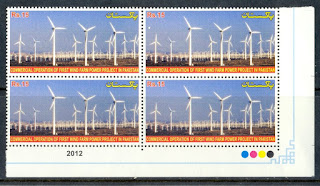
Inauguration of Commercial Operation of First Wind Farm Power Project in Pakistan. (2012-26)


Inauguration of Commercial Operation of First Wind Farm Power Project in Pakistan. Commemorative Postage Stamp December 24, 2012:- Alternative Energy Development Board (AEDB) is striving hard to give a boost to wind power generation in the country and expeditiously carrying in out multidirectional activities to commence wind farm projects in wind potential sites. AEDB has been endeavoring to harness and capitalize the colossal wind energy potential available in the coastal areas of the country. Through continuous promotion, AEDB has been able to attract and engage private national and international investment in this sector. Private sector has been triggered to invest in wind power. Currently, 47 Wind Power Projects of around 3300 MW capacity are in process.
GoS leased around 26,000 acres land to AEDB for 18 projects of cumulative 906 MW capacity. These projects are at various stages of development. A brief account of these projects is as follows:
·         Following three projects of cumulative 156 MW capacity are under construction
·                     49.5 MW FFC Energy LTD., Jhampir, Sindh – Construction and testing completed, ready for commissioning
·                     56.4 MW Zorlu Enerji (Pvt.) Ltd., Jhampir, Sindh – Construction completed, testing stated, will be commissioned in March 2013
·                     50 MW Three Gorges First Wind Farm Pakistan (Pvt.) Ltd., Jhampir, Sindh – Construction underway
·         Following two projects of cumulative 100 MW are going to achieve financial close by the end of this year
·                     50 MW Foundation Wind Power I Ltd. Khuttikun, Gharo, Sindh
·                     50 MW Foundation Wind Power II (Pvt.) Ltd., Khuttikun, Gharo, Sindh
·         Following eleven projects of cumulative 550 MW will be achieving financial close by 2013
·                     50 MW , Luck Energy (Pvt.) Ltd. Jhampir, Sindh
·                     50 MW Tenaga Generai Ltd. Khuttikum, Gharo, Sindh
·                     50 MW Sapphire Wind Power (Pvt.) Ltd. Jhampir, Sindh
·                     50 MW Metro Wind Power Co Ltd. Khampir, Sindh
·                     50 MW Gul Ahmed Wind Power Ltd. Jhampir, Sindh
·                     50 MW Master Wind Energy (Pvt.) Ltd. Jhampir, Sindh
·                     50 MW Sachal Engineering Works (Pvt.) Ltd. Jhampir, Sindh
·                     2 x 50 MW Wind Eagle (Pvt.) Ltd. Jhampir, Sindh
·                     50 MW Dawood Power (Pvt.) Ltd. Bhambore, Gharo, Sindh
·                     50 MW New Park (Pvt.) Ltd. Gharo, Sindh
·                     Wind power projects of 1000 MW are in pipeline
·         GOP has announced Upfront Tariff of US cents 14.66/kwh for prompt development of wind power projects
·         Investors are taking keen interest to execute project on this tariff. The investors are requesting allocation of land for their projects. Taking into consideration the available potential, the number of investing companies and quantum of up-coming wind power projects in the area, AEDB, has requested GoS to identify and allocate 100,000 acres more government land for wind power projects at wind potential sites in Sindh province.
·         The wind energy market has been made conductive through various prolific measures. A few of them are stated below:
·                     Grid Code has been amended to accommodate wind power
·                     Standardized project documents are prepared for projects having tariff on cost plus basis and made available to investors; standard project documents for projects opting Upfront tariff are drafted and are under discussion
·                     Lenders confidence is built through supportive measures
·                     Almost all renowned wind turbine manufactures are in the market to supply equipment
·                     Local capacities are being developed for EPC services and for manufacturing of towers locally
·                     Generalized environmental study conducted for whole Gharo, Sindh Wind corridor for prompt processing
·                     Short and medium term grid integration planning study conducted for integration of 1000 – 1500 MW wind power
·                     Security issues of the investors at project sites are addressed with the support of GoS
The time has reached when Pakistan is going to enter into a new era in energy sector as wind power is going to have commercial operation in the country for the first time in its history. The 49.5 MW wind power project of M/s FFC Energy Ltd. (FFCEL) installed at Jhampir, district Thatta, Sindh is expected to achieve Commercial Operation Date (COD) in December 2012. The project has already been operationalized and connected to the national grid and has started dispatching test energy. It’s formal “Commercial Operation” is expected to start on 24th December 2012. This has become possible owing to dedicated efforts by the government and private sector entities. This would become a strong foundation for the wind power development that has over 50,000 MW potential only in Gharo corridor and is expected to take a significant place energy mix.
Pakistan’s entry into the list of countries that are commercially deploying renewable energies for meeting energy needs to be celebrated, particularly as this is the first of many projects that are in the pipeline. The event is historic as this is advent of a new technology in Power Sector, which marks the beginning of the era of clean, indigenous and cheaper sources of energy. The Federal Government is intending to hold an inauguration ceremony to celebrate this achievement at the start of commercial operation of this power plant that is planned on 24th December 2012. President / Prime Minister are expected to be the Chief Guest of this event.
On the occasion of inauguration of commercial operation of first Wind Farm Power Project in Pakistan, a commemorative postage stamp of Rs. 15/- denomination is being issued by Pakistan Post on December 24, 2012.

60 Years of Oxford University Press in Pakistan. (1952-2012) (2012-25)


60 Years of Oxford University Press In Pakistan Commemorative Postage Stamp December 15, 2012:- Oxford University Press is a department of the University of Oxford. It furthers the university’s objective of excellence in research, scholarship, and education by publishing worldwide, with branches in almost 50 countries.
Oxford University Press Pakistan (OUPP) celebrates 60 years of publishing this year, 2012. OUPP was established in 1952 with a branch office in Karachi, the first overseas publishers in Pakistan. Since then OUPP has been a success story in terms of expansion throughout the country, including Dhaka (pre-19714) with the Head Office in Karachi, Branch offices in Lahore and Islamabad, and offices and bookshops in all major towns and cities. With steady growth in output and number of staff in the Head Office, OUPP is housed today in custom-built premises in Korangi, comprising a classic, five-floored structure clad I nyellow, Gizri stone, designed by the Heritage architect Kamil Khan Mumtaz, to showcase Pakistan’s rich cultural heritage. The premises also have a spacious, purpose-built warehouse. The foundation of this building was laid in 1999 and the building was inaugurated in 2005, although OUPP had moved into the new premises in early 2003.
In terms of publishing, OUPP broadened the spectrum and diversity of its educational and general titles, and set a record for itself in the Sixties with the Ahmad and Rehana English language series that enjoyed country-wide popularity. Beginning with a modest publishing plan that comprised mainly reprints and adaptations, OUPP today publishes a fairly large number of original and well-researched school, higher education, and academic titles per year. The academic and general publications of OUPP are authenticated texts thatare authoritative sources of reference. OUPP today is a symbol of high quality in both content and presentation of its books. In 1997, OUPP published the Jubilee Series to celebrate fifty years of Pakistan’s independence. The Jubilee Series boasted works by well known and highly respected authors at home and abroad whose writings chronicled the history, society, culture, and literature. Committed to the promotion of education in Pakistan, OUPP has made good quality educational books accessible for all levels. OUPP publishes a wide range of school books for all subjects with focus on quality of text, excellent illustrations and user-friendly layouts. Most of OUPP’s O level books, especially commissioned and kept in sync with the latest O level syllabuses, are endorsed by the examining body. Almost all titles in the school educational series are supported by Teaching Guides that offer lesson by lesson explanation, answers to textbook questions and lesson plans and worksheets. Another first from OUPP is the extension of academic support to schools across the country by arranging Teacher Training Workshops as per demand for selected series and titles. This guidance and interaction with the workshop leaders and amongst themselves greatly facilitates teachers in accessing resources, planning lessons, activities, and assessments. Needless to say, OUPP Teacher Training Workshops are widely welcomed by the users of OUPP’s school publications.
Another feather in the OUPP cap are the bi-lingual dictionaries; OUPP made a mark for itself by commissioning the renowned scholar and lexicographer, Shan ul Haq Haqqee to publish the Oxford Urdu-English Dictionary based on the concise Oxford English Dictionary, which hwas launched in 2003. Work is in process for the Oxford Urdu-English Dictionary, which will be an equally valuable resource for scholars in particular and readers in general. In keeping with this tradition, bi-lingual dictionaries have been published in Sindhi as well as Pashtu, as well as dictionaries for primary, secondary and tertiary levels. OUPP supports the children’s reading programme through attractive and colourful supplementary readers.
Moreover, OUPP has actively promoted the reading habit through ongoing national book fairs, and was the moving spirit behind the first ever Karachi Literature Festival (KLF) and Children’s Literature Festival (CLF), which are now regular events on the readers’ calendars. These events are well attended – in fact, packed, as they feature book launches, interviews, panel discussions and also a range of activities for children that introduce and educate them to the charm of the printed word, as well as engaging their interest. The Karachi Literature Festival not only brings together national and international writers, scholars, reviewers in interaction with the audiences, but has also dispelled fears about Pakistan in terms of safety and security. The other two most effective initiatives for promoting the reading culture and bringing books within reach of the readers are the Oxford Mobile Bookshop for all levels and genres, and the Oxford Mobile Library. The Mobile bookshop has travelled all over the country, from the shores of Sindh to the heights of Swat with its treasures of knowledge. The Mobile Library, OUPP’s latest venture, is a boon for readers in the absence of public libraries. It is particularly advantageous for underprivileged areas as it provides access to books at the readers’ doorstep.
OUPP has come a long way from 1952, no doubt, but the journey continues towards further success and achievements.
To commemorate celebration of the 60 Years of Oxford University Press in Pakistan, a commemorative postage stamp of Rs. 15/- denomination is being issued by Pakistan Post on December 15, 2012.

Muhammad Luthfullah Khan 1916-2012 (2012-24)


Muhammad Luthfullah Khan (The Archivist) 1916 – 2012 Commemorative Postage Stamp November 25, 2012:- Muhammad Luthfullah Khan, an Archivist, a Photographer and a Writer, was born at Madras (now called Chennai) on November 25, 1916. His father used to work for the South Indian Railways. He was educated in Madras but moved to Hyderabad later to Mumbai in search of employment. He had extra ordinary fascination for music and singing from his childhood. He participated as amateur singer at the Madras Boys and Girls Exhibition in the year 1931 and received the merit award for Hindustani Music. He signed an agreement  in 1933 for classical singing with the Indian State Broadcasting Service, later re-named as All India Radio. He performed publicly at the age of 19, during a radio concert in 1935. Known as Madras Radio Artist, he sang Ghazals at a function of Muslim Students Association of St. Xavier’s College in January 1939 and rendered classical singing at Bombay in December the same year. After partition he left India and came to Pakistan on October 17. 1947 and settled in Karachi. During quarter century of daily practice (1963 – 1988), he practiced singing with Maulana Abdul Shakoor (newphew of Ustad Abdul Karim Khan) and explored the intricacies of only one raag, the Darbari.
As a young writer his books (Pehloo, Dukhti Ragaeen etc.) were published in early 1936. He performed his first sound recording (voice of his mother) on 29th of July 1951 by using “Sound Mirror” tape recorder, having a single speed of 7.5 inches Per second. Paper tape, coated with magnetic material, was used.
His museum gallery displays rare photographs, photography equipment, international and Pakistani coins, a set of 12 inch 78 rpm discs of Late “Barey Ghulam Ali Khan Sahib”, sound recording equipment and accessories, drawing instrument and stationary items used in documenting the collections and personal items of nostalgic importance as well as a wonderful matchbox collection. (This was his main hobby also). But the pick of this array is an album containing posters of old Hindi and American movies, some of them dating back to twenties. (Late Mr. Theodore Phailbus had the most wonderful collection of Posters in Pakistan). All are arranged in properly illuminated showcases and display boards.
Electronic devices installed include “Revox” tape recorders. Such a broad based collection requires periodic maintenance for which he gas established in a separate room a small workshop with inventory of spares and tools.
His archive contains a large number of rare books on a variety of subjects, including religion. In this personal files, papers are arranged in chronological order in a healthy state. Indexing has been done in simple manner to facilitate easy location of the desired document. His monumental work is un-paralleled in the literary history of the sub-continent.
Different articles were published on his work in the newspapers and magazines. Up to the year 2001, the total number of such essays was 185. Muhammad Luthfullah” Khan penned down eight books pertaining to Urdu literature, Islamic Studies, history and those informing about the lives of great poets and prose writers including:-
1.    Tamashaey – Ahley – Qalam
2.    Sur ki Talaash
3.    Hijratoun key silsiley
4.    Zindagi ka Safar
He has tanscribed all the Urdu Ghazals of Mirza Ghalib into Roman Alphabets. His library comprises the following six categories:
1.    Music of the subcontinent.
2.    Urdu literature – Poetry (Ghazals, Marsia, etc.) and Prose (Novel, Tanqeed etc.)
3.    Religion (Religious books – recitation and narration)
4.    Speeches of public figures including Mr. Mohammad Ali Jinnah, Mr. Liaquat Ali Khan and Mr. Z.A. Bhutto
5.    Education – Mainly Music and Urdu Literature.
6.    Art – Fine Arts, Interviews supported with transparencies, Musical Instruments description with slides.
The music section is further categorized as under:-
1.    Instrumental
2.    Pure Classical
3.    Semi Classical
4.    Ghazal
5.    Geet
6.    Folklore
7.    Qawali
The taped recordings of each category are contained in different colour boxes. Original Gramophone records have been preserved.
Muhammad Luthfullah Khan, till the age of 96 was working to collect cassettes of Urdu verse and prose. He had archived a wide variety of more than 5,000 voices including the speeches of Quaid-e-Azam Muhammad Ali Jinnah, Mahatma Gandhi, Maulana Abdul Kalam Azad and poetry of great poets like Faiz Ahmed Faiz, Friaq Gorakhpuri, Josh Maleeh Abadi, Noon Meem Rashid, Hafeez Jalandhri, Akhtar-ul-Iman and many other eminent poets. Faiz Ahmed Faiz has gifted recording of his poetry in his voice.
Muhammad Luthfullah Khan has computerized his directory of musical collection. The same Raag is indexed for different instruments and vocalists. Among the vocalists he often listens to, with devotion, are Salamat Ali Khan, Amanat Ali Khan, and Roshan Ara Begum. His most liked Vichtarveena player in Pakistan is Habib Khan. Other outstanding instrumentalists include Ustad Bundoo Khan for “Sarangi” and Sharif Khan Ponchwala for Sitar. He considers Villayat Khan as unique in playing of Sitar.
Most of the catalogues have been prepared through computer in the shape of properly bound hard copies. It was too much of a work to be done by a single person.
This is the lifetime achievement of a dedicated hobbyist – indeed a wonderful work, which may not have a match in the Subcontinent.
His birth place in India (Madras / Channai), is said to have another collector of old records namely Mr. V.A.K. Ranga Rao.
In recognition of his splendid contributions to the field of Art, Literature and Culture, which was span on more than 70 years, especially pres4erving national and international Heritage in shape of cassettes, CDs and books, he was conferred upon a large number of awards from different organizations and circles indlucing Presidential Award for Pride of Performance by the President Islamic Republic of Pakistan in 2012, National Literary Award for the year 1998 on his book “Hijratoon Ke Silsle” and Kamal-e-Fun Award (Life time achievements) awards by the Pakistan Academy of Letters, Islamabad.
Muhammad Luthfullah Khan, passed away on Saturday, March 3, 2012 at the age of 96. He was committed and devoted person who spent most of his life collecting voices from different walks of life.
To pay tribute Muhammad Luthfullah Khan (The Archivist), Pakistan Post is issuing a commemorative postage stamp denomination of Rs. 15/- on November 25, 2012.

Fifty Years of National Investment Trust. NIT. (2013-23)


50Th Anniversary of National Investment Trust Ltd. (NITL) Commemorative Postage Stamp November 21, 2012:- It is an occasion of immense pleasure and pride for NIT to complete its 50 years of successful operations in the mutual fund industry. The institute has been providing un-tiring service to small, medium and large investors and has now entered the period to commemorate celebrations of its Golden Jubilee.
National Investment Trust Limited (NITL) is the pioneer Asset Management Company in Mutual Fund Industry and carries a market share of around 18% of the entire mutual funds industry where as NIT’s equity funds constitute 86% of the industry’s open end equity funds. It was established in 1962 and has the credit of being the First and Largest Asset Management Company of Pakistan with the Net Assets under its management of around Rs. 74 Billion as on June 30, 2012.
NIT’s Mission is to serve the investors by providing best possible return on their investments and to invest in the Capital Markets in a manner, which could provide depth for the investors’ and necessary capital to the industry. Over vision is to be recognized as the beacon of positive change in the Capital Markets. Leading by example, with an aim to provide the necessary opportunity to all the stakeholders and to contribute towards healthy growth of the Mutual Fund Industry.
NIT’s operational network spreads all over the country with 23 own branches and 01 centralized Investors’ Faciliation Center (IFC) in Karachi. In addition, various authorized bank branches are facilitating our investors. The Company is also represented in Dubai (UAE) by Arab Emirates Investment Bank (AEIB) and is catering to the needs of around 57,256 unit holders as on June 30, 2012. NITL has assigned a credit rating of AM2 – by PACRA, which reflects that the company has a very strong capacity to manage risks.
Over the years, NITL has expanded its product line to meet requirements of the investors depending upon their risk absorption appetite. Presently, the Company is managing a total of Five Funds, 3 Equity and 2 Fixed Income Funds.
Equity Funds:- i) NI(U)T Fund:- It is NIT’s flag carrier Open Ended Equity Fund and was launched in November 1962. Net assets of the Fund as on June 30, 2012 amounted to Rs. 41.487 billion. As on August 31st 2012, around 91.52 percent of the Fund remained invested in equities with around 36 percent investment in Oil & gas and Banking Sectors. The core objective of the Fund is to maximize return for Unit Holders and to provide a regular stream of current income through dividends. In addition, long-term growth is achieved through management of a diversified portfolio and investments in growth and high yielding equity securities. The risk profile of the fund is moderate to high and the fund provided a 10 year annualized return of 21.81% during FY12, NI(U)T earned a return of 7.57%. During its entire life history, the Fund has been consistent in paying dividends to its unit holders and has paid a per unit dividend of Rs. 3.50 in FY12.
ii) NIT-State Enterprise Fund (NIT-SEF):- NIT-State Enterprise Fund (NIT-SEF) was launched in January 2009 with an objective to take advantage of market conditions and acquire a selection of Eligible Stocks thereby creating an opportunity for investors to achieve superior returns. The Fund has an investment mandate to invest in eight state owned / controlled enterprises. It is an Open Ended Equity Fund, with moderate to high risk profile. The fund earned a return of 6.1% in FY12 whereas its return since inception until August 31, 2012 has been 199.23% against the benchmark return of 154.77%. The Fund paid a per unit @ 9.30% on the face value of Rs. 50/- for the unit holders of NIT-SEF in FY12. NIT will shortly offer this Fund to general public for investment.
iii) NIT-Equity Market Opportunity Fund (NIT-EMOF):- This Open Ended Equity Fund was launched in July 2008 with an objective to invest funds in the Equity Market at a time when Management Company of the Fund has reasons to believe that there is an opportunity to invest the Fund in a gainful manner and such investment is in the benefit of the Fund taking a long term perspective. The Fund generated a return of 18.04% for its investors in FY12 whereas its return since inception until August 31, 2012 has been 63.41%.
Fixed Income Funds:- i)NIT Government Bond Fund (NIT-GBF):- NIT Government Bond Fund was launched on 18th November 2009 with the objective to generate best possible return with minimum risk for its Unit Holders by primarily investing in securities issued by government of Pakistan. The risk profile of the Fund is low. As of August 31, 2012 95.08% of the Fund is invested in Treasury Bills. The total annulized return of the Fund during FY12 was 9.76%. Further since inception until August 31, 2012 NIT-GBF earned an annualized return of 11.82% against benchmark of 140.81%. With anticipation of further easing in the policy rates, NIT-GBF has increased its weighted average time to maturity of portfolio from 154 days to 185 days.
ii: NIT Income Fund (NIT-IF):- This Open End Income Fund was launched on 19th February, 2010 with an objective to generate a competitive stream of return with moderate level of risk for its investors. The Fund is primarily invested in a diversified portfolio comparising of high quality debt Securities & Instruments. As of August 31, 2012, around 62.27 percent of the Fund is invested in Treasury Bills whereas majority of the remained is invested high quality TFCs. The total annulized return of the fund during FY12 was 12.34% whereas, since inception until August 31, 2012 return has been 12.96% against benchmark rate of 12.71%.
NIT is commemorating 2012 as its Golden Jubilee Year. Special Giveaways are prepared to share with our clients and unit holders on this momentous occasion. Newspapers will publish special supplements on 12th November 2012. Pakistan Post is issuing a collection stamp in commemoration of achieving this milestone by a National Organization.
On the occasion of 50th Anniversary of National Investment Trust Ltd. (NITL), Pakistan Post is issuing a commemorative postage3 stamp of Rs. 15/- Denomination on November 21, 2012.

Diamond Jubilee of Department of Geography University of Karachi Pakistan. (2012-22)


Commemorative Postage Stamp on Celebration of Diamond Jubilee of Department of Geography University of Karachi November 19, 2012:- One of the primate departments of the university, Department of Geography was established in November 1952. Its first Chairman, Dr. M.B. Pithawala was followed by Dr. Oskar Schmeider, Dr. Ibadur-Rehman, Dr. Shamsul Islam Siddiqui, Dr. Muhammad Ismail Siddiqui, Prof. Abdur Rauf Khan, Mrs. jamilaSarwar, Dr. Fazla Karim Khan, Dr. Iqtiday Husain Zaidi, Dr. Qazi Shakil Ahmed, Mr. Syed Asif Ali, Dr. (Mrs.) RAzia Afzal Niazi, Prof. Dr. Birjies Talat, Prof. Dr. FArkhunda Burke, Prof. Dr. Syed Jamil Hasan Kazmi, Prof. Dr. Khalida Mahmood and the current Chairperson Prof. Dr. FArkhunda Burke who have earnestly and painstakingly taken the department from its inception to the status of a glittering diamond. The department has been fortunate to be served by eminent, internationally reputed geographers and faculty including the uncoming, enthusiastic faculty members.
The department is housed in a two-storeyed building with lecture rooms, research laboratory, a well catalogued seminar liberary, staff rooms, girls’ common room etc. The Seminar Library containing more than 2000 books acquired by the department, through donations by retired teachers and ex-students, caters to the needs of more than 450 students. The Map Library containing about 3000 maps, ranging from topographical maps of various areas, maps of various cities and administrative maps of different scales; some aerial photographs and satellite imageries are available in the Department. The wall maps along the corridors pertaining to various regions of the world, and varying fields of geographic specialization give the department a geographic air. Satellite imageries of Pakistan and Karachi mounted on the elevations, express that maps are an essential tool of geography.
New perspectives in geography have evolved with the advent of Geographical Information System (GIS), Remote Sensing (RS) and Computer Aided Design (CAD). The department boasts of a computer laboratory for hands on working of students. A fully computerized research laboratory has been inaugurated by the Dean Faculty of Science, Prof. Dr. Nusrat Jamil, to cater to the thirty two registered research scholars.
An ‘A’ class Meteorological Laboratory established in 2003, in the foreground of the department is located on the WMO map. Regular reading are regularly dispatched by Supporting Staff trained for this purpose. The Abdur Rauf Khan Museum of Pre-History, contains relics of pre-historic cultures of Pakistan, collected from an area extending to about 120 miles around Karachi. The material ranges from early Paleolithic age through Middle and upper Paleolithic, Mesolithic and Neolithic to Harappan Age. Vertebrate fossils of Miocene Age derived from Sindh Kohistan and coastal areas of Sindh and Balochistan are on display in the museum.
To commemorate Celebration of Diamond Jubilee of Department of Geography University of Karachi, Pakistan Post is issuing a commemorative postage stamp of Rs.15/- denomination on November 19, 2012.

92nd Birth Anniversary of Hameed Naseem. Men of Letters. Pakistan (2012-21)


92Nd Birth Anniversary Of Hameed Naseem Commemorative Postage Stamp October 19, 2012:- Hameed Naseem was Mufasser-e-Quran, Poet, Writer, Critic, former Deputy DG Radio Pakistan, former Director of the PIA Arts Academy, an acclaimed broadcaster and was called “broadcaster” by critics and his contemporaries. He was born on 6th October, 1920 at Shah Pur Kundi, District Gurdaspur. He was a prodigious learner and poet and started writing poetry at an early age in School days. He got opportunities to intermingle with poets and intellectuals like Faiz Ahmed Faiz and Dr. M.D. Taseer who were close friends of his father Abdul Aziz, known as Aziz Bitalvi, who had profound interest in poetry. He matriculated from M.B. High School Lahore and graduated from MAO College Amritsar. Later he moved to Lahore and did his M.A. Engilish from Islamia College Lahore where he was the leading poet, orator, and prose writer of the College and was especially known for his melodious voice (taranum) which always swayed the mushairas by its profound effect. During these days, he was a regular visitor of the famous Arab Hotel, which lay across the Islamia College Lahore and Nageena Bakery near Anarkali; both places were established rendezvous for the literati, poets, and scholars of the thirties and early forties and other intellectual community of Lahore. It was during this time that he received poetic inspiration and guidance from Sufi Tabassum and developed lifelong friendship with him as well Zia Jallandari, a leading poet and who regularly prodded poet inside him and motivated him for other research and literary endeavors.
His Tafseer-e-Quran, named, Ta’aruf Al Furqan, is composed of 5 volumes and provides in-depth and detailed commentary on Quran, with references to comparative religions. He wrote booklets, Aurat Islam Ki Nazar Main, for general readers to remove their some misconceptions about the role of woman in Islam and The Message of Islam, for the English speaking communities for better understanding of the basic Islamic concepts.
He was a promising poet of his times and his collection of poetry, Dood-e-Tahayar (The Smoke of Wonderment), is an important work of classical ghazal structures, and shows his confident grasp of the art of poetry writing which is guided by the rules of poetry and its rhetoric. His collections of poetry, Jast-e-Janoon, Gard-e-Malal, are also rated as valuable to Urdu literature. He was also a known critic who wrote critique on many poets and his book, Allama Iqbal Hemaray Azeem Shaaer, Panch Jadeed Shair, Kuch Aur Ahim Shair, introduction to Kuleeyat Shafeeq Fatima, are widely acclaimed among the literati circles. His book, “Allama Iqbal Hemaray Azeem Shaaer” was awarded Presidential Award posthumously on Iqbal Day in 2003 which was received by his widow, Nafisa Begum, and daughter, Seemin, from the President of Pakistan at the occasion of Iqbal Day in Lahore.
Notwithstanding his great contribution of producing 5-volumes’ of comparative religion commentary on Quran Hakeem, his autobiography Namumkin Ki Justajo, published in 1990, will remain his most memorable work and is still rated one of the best autobiographies in Urdu literature. This autobiography is unique in two ways – firstly, it is written in third person and secondly, it shows a picturesque kaleidoscope of cultural and literary life in Lahore and Amristar and in many parts of the world in those times, wherever he lives or visited, which have now vanished, and his contemporary personalities and events. It vividly portraits the days at MAO College Amristar, Islamia College Lahore, early days of Radio, and events of his colleagues like Meeraji, Noon Meem Rashid, Krishan Chander, greatest of them all, Prof. A.S. Bukhari, the first Indian to become Director of All-India Radio. Due to these peculiar characteristics of this autobiography, it has been called Ahad Nama by the critics.
Mr. Hameed Naseem also served as Director of the PIA Arts Academy in 1967 for few years and used his talents as a programme person in the promotion of Pakistan art and culture at international levels, mostly the destinations of the PIA at those times. At the twilight of his life and career, Mr. Hameed Naseem was researching and writing, Adbi Urdu Nasar, which could not be published due to his sudden death in 1998 and is still available with his heirs as a manuscript.
He was one of the pioneers and founders of Radio Pakistan after the creation of Pakistan. He started daily programme, Pakistan Hamara hay, from Radio Station Lahore which tried to inculcate national integration among the newly founded nation. He wrote many national songs (Qaumi Taranay) during the wars of 1965 and 1971 which were sung be eminent singers like Ustad Amanat Ali, Farida Khanum, Noor Jeha,. He had a long career in Radio Pakistan and was widely respected as a famous broadcaster and many posthumously remember his reputation as broadcasters’ broadcaster. He also served at BBC in London for few years on deputation but returned to Pakistan for love of the people and the country and declined all lucrative offers of staying at the BBC. The BBC remembered his contributions by placing a floral commemorative wreath on his grave after his death. He strated the programme, Roshni, and Quran-i-Hakeem aur Hamari Zindigi and conducted the programme himself for years in his typical broadcaster’s voice. This religious programme was so much popular among the listeners that it was broadcasted for decades till recent years. He was also founder of the Radio Station Hyderabad and appointed its first Station Director. Hameed Naseem retired as Deputy Director General but kept serving the Radio Pakistan as Advisor on Religious Affairs till the time of his death, and even performed his duties on the last day of his life, 28th September 1998.
His death was widely mourned in the literary circles, Radio Pakistan, PTV, and the electronic media relayed news and the print media published news reports as well as special features. Many famous poets and writers wrote obituaries in the national dailies and Literary Magazines, acknowledging his contributions for the Urdu literature, religion and Radio Pakistan. Hameed Naseem will always be remembered for his valuable contributions to Urdu literature, Poetry, history of Pakistan, and most importantly expounding our great religion.
On 92nd Birth Anniversary of Hameed Naseem, Pakistan Post is issuing a commemorative postage stamp of Rs.8/- denomination on October 19, 2012.

Friday, October 5, 2012

Wetlands Of Pakistan. The Arabian Sea Coral Reefs. (2012-20)


Wetlands of Pakistan The Arabian Sea Coral Reefs Commemorative Postage Stamps October 4, 2012:- Coral Reef Discovery Along Makran Coast, (Arabian Sea) Pakistan:- Coral Reefs are the “Rainforests” of the ocean. Reefs are ecologically important ecosystems and have a high biodiversity that serves as a storage bank of rich genetic resources. They are a source of food and medicine, and they protect the coast from wave erosion. Scientists have found an abundance of compounds to help fight heart disease, asthma, cancer, HIV and more.
Coral reefs are structure made of limestone deposited by living organisms. Although thousands of species inhabit coral reefs, however, only a fraction production produces the limestone that build the reef. The most important reef building organisms are the corals. Although there are hundreds of different species of corals but in general they are classified as either hard or soft coral. Hard corals (hermatypic) grow in colonies and are the architects of coral reefs.
Coral reefs are one of the oldest environments on earth. Most of the existing reefs have been growing from over 5,000 years.
There are three basic kinds of coral reefs: fringing reefs, barrier reefs, and atolls. Fringing reefs grow in shallow waters close to the coast. Barrier reefs are separated from land by lagoon, growing parallel to the coast and forming a large and continuous reef. Atolls are ring-shaped reefs that develop near the sea surface on underwater islands or island that sink, or subside.
Coral reefs are vital to coastal fisheries. It provide spawning, nursery, refuge and feeding areas for a large variety of organisms, including economically important crustaceans (e.g. shrimps, spiny lobsters and crabs).
A field mission of the Pakistan Wetlands Programme (PWP), lead by coral expert from Millport University, UK, indentified the first ever coral reef ecosystem near the Astola Island. Before this discovery it was blindly believed that coral reefs are not existed in Pakistan’s jurisdiction of the Arabian Sea.
The basis of information collected about coral reef associated fish species from the fishing areas near Gwader, an expedition team encompassing divers from PWP and Pakistan Navy conducted a survey of the possible coral sites in 2011 and discovered large area of deep sea coral near Gwader. This underwater survey was conducted in five sites in Gwader along the Arabian Sea. The most significant sites were: Cher Koh, Baladi Koh and Ganjabad. The coral colonies occurring at the Cher Koh, Baladi Koh and Ganjabad are mostly in growing stage and present a healthy condition.
Coral cannot survive it the water temperature is too high. Global warming has already led to increase levels of coral bleaching and this is predicated to increase in requency and severity in the coming decades. Adverse affects of this phenomenon cannot be avoided in terms of reefs ecosystems along Makran Coast.
On Wetlands of Pakistan (The Arabian Sea Coral Reefs), Pakistan Post is issuing a set of four commemorative postage stamps each denomination of Rs.8/- on October 4, 2012.

Monday, October 1, 2012

GOLDEN JUBILEE AYUB BRIDGE 1962-2012 (2012- 13)


Golden Jubilee of Ayub Bridge Commemorative Postage Stamp June 15, 2012:- The bridge was designed by Dr. D.B Steinman of New York and it was constructed by Doman Long Ltd (German) in association with M.S Gammon Construction Ltd. (Pakistan. Construction of Ayub Bridge was commenced on November 26, 1959 and completed on March 17, 1962. Total cost of the bridge at the time of construction was 21.6 million Pak rupees. The bridge was inaugurated by the then President of Pakistan, Field Marshal Muhammad Ayub Khan and opened for Rail traffic on May 6, 1962.
This is Steel Arch Suspension Bridge. The height of Crown of arch above bearing is 204.7 feet. The quantities of steel, High Tensile steel and Mild steel are respectively 131 tons, 1002 tons (main chord) and 1907 ton (rest of the portion of bridge). Span of the bridge is 806 feet and 9 inches.
The road over the Sukkur barrage involving a distance of 13 kilometers betweenSukkur and Rohri Railway Station remained the only road connection between Sukkur and Rohri. It was decided to utilize the Lansdowne Bridge for road traffic by providing a roadway. The work was started on December 16, 1963 and completed on June 10, 1964. By opening of roadway the distance for the road taffic between Sukkur and Rohri was reduced to 5 kilometers as against 13 kilometers over the Sukkur Barrage. Lansdowne Bridgte was a road bridge and it is still in working condition having full functional capacity. There is a beautiful Hindu sacred shrine in downstream of this bridge with a graceful Army Restoration.
It has a proper decking for Army purposes. It may serve as a road bridge as well as an emergency bridge during war time. Even the heaviest vehicle like Tanks can also easily cross over this bridge. It is truly called as the masterpiece of Railway Engineers.
There was no such engineered arch at that time in Asia, when this arch of 800 meters was buils in 1962. Even today as it stands, has the third largest arch’s position in Asia. Ayub Bridge has been constructed with the help of such a fine and best quality material that it still stands in its original state. While coming from Lahore to Rohri, this gigantic bridge can be easily seen from a distance of 04 kilometers.
On the Golden Jubilee of Ayub Bridge, Pakistan Post is issuing a commemorative postage stamp of Rs.8/- denomination on June 15, 2012.

L68- PAKISTAN 40TH ANNIVERSARY UNITED NATIONS UN ENVIRONMENT PROGRAMME. (2012-12)


40th Anniversary of United Nations Environment Programme Commemorative Postage Stamps June 5, 2012:- Environmental issues in Pakistan threaten the population’s health and have been distributing the balance between economic development and environmental protection. As a great problem for the nature and nation of Pakistan and As Pakistan is a large importer of both exhaustible and renewable natural resources and a large consumer of fossil fuels, the Ministry of Environment of Government of Pakistan takes responsibility to conserve and protect the environment.
Conservation Efforts:- The government has expressed concern about environment threats to economic growth and social development and since the early 1990s, has addressed environmental concerns with new legislation and institutions such as a Pakistan Environment Protection Council. Yet, foreign lenders provide most environmental protection funds, and only 0.04 percent of the government’s development budget goes to environmental protection. Thus, the government’s ability to enforce environmental regulations is limited, and private industries often lack funds to meet environmental standards established by international trade organizations.
National Conservation Strategy (NCS):- The National Conservation strategy has three explicit objectives: (i) Conservation of natural resources, (ii) Promotion of sustainable development, (iii) Improvement of efficiency in the use and management of resources. It sees itself as a “call for action” addressed to central and provincial governments, businesses, and Non-governmental organization (NGOs), local communities, and individuals.
The National Conversation Strategy recommended fourteen programme areas for priority implementation: maintaining soils in croplands, increasing efficiency of irrigation, protecting watersheds, supporting forestry and plantations, restoring rangelands and improving livestock, protecting water bodies and sustaining fisheries, conserving biodiversity, increasing energy efficiency, developing and deploying renewable resources, preventing or decreasing pollution, managing urban wastes, supporting institutions to manage common resources, integrating population and environmental programs, and preserving the cultural heritage. Special attention has been paid to the potential roles of environmental NGO’s, women’s organizations, and international NGO’s in working with the government in its conservation efforts.
The average temperature in Pakistan had risen by 0.2 degrees in only 2 years, This is a dramatic change and puts emphasis on Climate Change Campaigns. In the 1980s World Wildlife Fund (WWF), United Nations Environmental Programme (UNEP) and  International Union for Conservation of Nature (IUCN)-World Conservation Union collaborated to formulate the World Conservation Strategy to ‘save the world’. After IUCN started its work in Pakistan. The government and IUCN worked to formulate the National Conservation Strategy for Pakistan over a three-year period. The NCS is a plan to integrate environmental concerns into Pakistan’s economy. The implementation of the strategy started with the formation of institutions such as the Environmental Section in the Federal Planning and Development Division and the Sustainable Development Policy Institute.
Convention on Biological Diversity (CBD):- Pakistan ratified this convention in 1992 with 161 nations at the Earth Summit at Rio. Consequently, Pakistan became a contributor and beneficiary to the Global Environmental Facility (GEF) set up under the convention. It is also taking initiatives in community level projects to conserve biodiversity.
Ghazi-Barotha Hydropower Project:- The project has the capacity to produce 1,450 mw of electricity. With this project, the Water and Power Department for the first time took efforts to study the environment and to include environmental considerations.
UN Convention on Combating Destrification (CCD):- This is an international treaty for collaborative action against damage and poverty in drylands. Pakistan signed this in 1997 and is in the process of developing its National Action Plan to fight desertification, which afflicts about 45 million hectares. A local NGO, Society for Conservation and Protection of Environment (SCOPE) is active in this area.
Shehla Zia Case:- This was a case filed against WAPDA to halt the construction of a grid station near a residential area. The judgment given was in favour of the citizens and became a landmark decision in the field of environmental law in the country. This case set the precedent for subsequent environmental cases.
Maintaining Biodiversity With Rural Community Development:- IUCN – Pakistan and the Government of NWFP’s Wildlife Department jointly implement this project. Rural communities are active partners in this project and over 40 villages were involved in the first two years.
Sarhad Provincial Conservation Strategy (SPCS):- In 1996, the Government of NWFP approached IUCN to formulate and implement the SPCS. This was the principal plan to implement the National Conservation Strategy. The strategy has spurred the governments of Baluchistan and the Northern Areas to emulate this move.
Pakistan Environmental Protection Bill 1997 (PEPA):- PEPA supplements the 1983 Environmental Protection Ordinance with more functions for the Environmental Protection Agencies, and new laws dealing with pollution. It also rationalizes the Environmental Protection Council.
Year 2012 is the United Nations Environment Programmes’ (UNEP) 40th Anniversary. This marks four decades of service and achievements, which have assisted in catalyzing and evolving the environment as an integrated aspect of sustainable development vital for the social progress of now 7 billion people.
This is reflects in the logo slogan-“Serving People and the Planet”. The key to this message is that UNEP has not only been concerned with the conservation and more intelligent management of the planet but, just as important, serving its inhabitants.
On 40th Anniversary of United Nations Environment Programme, Pakistan Post is issuing a set of four Commemorative Postage Stamps each denomination of Rs.8/- on June 5, 2012.