My name is Wahid Zia. I am collecting stamps since the last 50 years (1976). I created a blog which includes the information of Pakistan all stamps. W/W new issues & all issues of Pakistan from 1947 to date are available on this blog. I invite you to visit my blog and get useful information.

Showing posts sorted by date for query Ahmed Ali. Sort by relevance Show all posts

Tuesday, April 28, 2026

75 Years of Establishment of Pakistan - Turkey Diplomatic Relations. September 13th, 2023 (2023-13)

The year 2022 has a special significance for Pakistan, as we celebrate the 75th anniversary of the country's independence. It is also a special occasion in our diplomatic history, as we commemorate the 75 years of establishment of diplomatic relations between Pakistan and Türkiye.

The diplomatic relations between the two countries were established soon after creation of Pakistan in 1947. Mr. Yahya Kemal Beyatli, the first Turkish Ambassador to

Pakistan, presented his credentials to Quaid-e-Azam Muhammad Ali Jinnah on 4 March 1948 and Mian Bashir Ahmed, Pakistan's first Ambassador to Türkiye, presented his credentials to President Ismet Inonu in June 1949.

The fraternal relations between the two peoples go back centuries and are embedded in a common religious, cultural, linguistic, and spiritual heritage. The legendary support provided by the South Asian Muslims to their brothers and sisters in Türkiye during its War of Independence in the early 20th Century remains immortalized in the collective memory of all Turks. Muslims of South Asia defied their colonial rulers and came out in defense of Türkiye at one of the most critical junctures of its modern history - leaving behind their homes and donating all their belongings for the Turkish cause. Pakistan's national poet, Allama Muhammad Iqbal captured in his poetry the revolutionary spirit of resistance that led to the renaissance of the Turkish nation during its War of Independence.

In fact, the diplomatic relations between Pakistan and Türkiye are the extension of the same historical spirit - often articulated in motifs like "heart-to-heart relations" and, "two countries, one nation" by leadership on both sides. Both countries come to each other's support on every occasion and platforms. Pakistan and Türkiye stand with each other in pursuit of a peace, prosperity and development and against all challenges.

In recent years, in particular after the establishment of High- Level Strategic Cooperation Council (HLSCC), bilateral relations have now been transformed into strategic cooperation. This highest bilateral mechanism between two countries at the leadership level has been instrumental in forging ever-greater ties in all sectors including trade, investment, banking, health, education, agriculture, defense, science and technology and tourism.

The milestone of 75th year of diplomatic relations provides us an opportunity not only to reinforce our unwavering ties but also transmit the tradition of unmatched fraternity and solidarity between the two nations to our future generations.

To commemorate the 75th year of diplomatic relations in a befitting manner, both countries have planned a range off events. As part of these activities; Pakistan Post is issuing a Commemorative Postage Stamp to mark this historical milestone. The Commemorative Stamp bears joint logo for celebrating the year 2022 as the 75th year of establishment of diplomatic relations between Pakistan and Türkiye.

On 75 Years of Establishment of Pakistan – Türkiye Diplomatic Relations, Pakistan Post is issuing the Commemorative Postage Stamp of Rs.20/- denomination on September 13th, 2023.

Monday, March 9, 2026

NED UNIVERSITY OF ENGINEERING & TECHNOLOGY, KARACHI (1921-2021) 100 YEARS OF EXCELLENCE. August 1, 2021(2021-6)

NED University of Engineering and Technology is one of the oldest institutions for teaching and producing engineering graduates in this country. It was founded as Prince of Wales Engineering College in 1921. The present name was given to it a few years later in recognition of generous donation by the family members of the well-known philanthropist, Mr. Nadirshaw Edulji Dinshaw. Historical records indicate that the need for qualified civil engineers for mega projects such as Sukkur Barrage led to development of this institution. After Pakistan came into being in 1947. NED continued to serve the nation. In 1977, it was upgraded as NED University of Engineering and Technology and relocated to its present main campus at University Road. More laurels were earned by the institution thereon. The prime pride of NED has been its graduates most of whom have done very well in their respective professional careers. NED alumnui have also played a pioneering role in various fields of engineering works after Pakistan came into being. Some domains of professional contribution include consultancy, professional advice, setting up laboratories, research, industrial development, technical training and education, collaborative assignments, entrepreneurship and expansion, quality assurance mechanisms, management of units, design innovations and several others. The work of this invaluable human resource has had far reaching impact over the period of time. Development of indigenous capabilities in design, management and operation of vital industries and enterprises, evolution and expansion of new forms of industrial arrangements in production and support for state policies of industrialization during various regimes are some salient mentions that have been vital for the progress and prosperity of the nation. In other words, this university has played a pivotal role in augmenting technological and industrial development by providing dependable cadres of engineering graduates. A sizable number of these graduates constitute the invaluable human capital in the form of overseas Pakistanis. They are gainfully employed or running their own enterprises in the Middle East, United Kingdom. United States, Malaysia, China, Europe and many other parts of the globe.

Many years ago, the university took the revolutionary step of obtaining ISO 9000 certification to structure a quality management system whichcould transparently ensure prescription and practice of quality oriented approaches throughout the campus. All attempts that tend to threaten academic discipline are nipped in the bud in the larger interest of students and their future. It may also be noted that about 40 percent students are girls. The numbers of the fairer sex is also increasing in ranks of the faculty. Gender sensitivity in terms of safety, security and facilities is a foremost objective the university administration. Providing a wholesome atmosphere to students, a large number of co- curricular and sports activities are regularly perfomed. Debates, exhibitions, seminars, conferences and other such events are a regular feature of the academic calendar. In addition, the students are also exposed to the needs of actual working environment through internships in the various industries. Industrial liaison directorate keeps close coordination and follow-up with industrial and public sector concerns of various ranks and profiles. The students in third year and other classes benefit from this vital exposure. In many cases, the employment of interns after graduation becomes guaranteed when the prospective employers view the potential and capacities of the students. As the country has launched China Pakistan Economic Corridor (CPEC) initiative, Chinese language (Level 1 & 2) is taught to all undergraduate students since the past two years. Besides, a community service programme for all the undergraduate students is a compulsory course where the students receive theoretical and practical association with a worthwhile community initiative in various sectors.

Institutions take ages to evolve. They take even greater time spans to depict their outputs and potential. But it is an even uphill task to maintain the high standards set during the process of evolution. The NED University has experienced a phase of rapid growth, expansion and development in its recent past. It now comprises three campuses via main campus on University Road, Latif Ebrahim Jamal Campus on Stadium Road and the City Campus on Maulana Din Mohammad Wafai Road. In 2019, the university also opened Thar Institute of Engineering, Sciences and Technology (TIEST) at Islamkot (Thar) to enable the bright young people of Sindh to benefit from quality higher education at their door steps. The classes already began in 2019.

For the future, the university is focusing on developing a broad based research culture amongst its faculty and scholars for accelerating generation of worthwhile contributions to knowledge in all the concerned domains. Here are some of the notable glittering stars of NED, Our Alumnui's, our pride:

Mr. Elahi Bux Soomro

Mr. Justice Zulfiqar Ahmed Khan

Syed Murad Ali Shah Syed Asaad Ayub Ahmad

Engineer Asfia Aleem

Mr. Sohail P. Ahmed

Senator Rukhsana Zubairi

Mr Najeeb Haroon.

Mr. Aftab Hussain Siddiqui

Mr. Firdous Shamim Naqvi

Mr Ashraf Habibullah

Mr. Naveed Sherwani Mr. Raghib Hussain

Mr. Asim Murtaza Khan

Mr. Saeed Anwar

Major General Khurram Anwar Qadri

Retd. Maj. General Raza Hussain (SUPARCO)

Ms. Farhat Ishtiaq

Mr. Mohammed Ali Shehki

Mr Ali Haider

On 100 Years of Excellence NED University of Engineering & Technology, Karachi (1921-2021), Pakistan Post is issuing the Commemorative Postage Stamp of Rs 20/- denomination on August 1, 2021.


Wednesday, March 4, 2026

10 Years Of Karnal Sher Khan Cadet College Swabi (2011-2021) (2021-1)

Evolution of Cadet Colleges:- The history of boarding colleges dates back tothe 18th century in Europe where these were first introduced in France by Napoleonand by Bismarck in Germany. The Military and Royal aristocracy used to send their children / wards for education as well as preliminary training for a career in theRoyal Army. The concept of military Cadet Colleges in British India, was introducedin 1922, with the start of Prince of Wales Royal India Military College, to serve as feeder institution and nursery to the Military. It was Rashtria College in India and Military College Jhelum (Sarai Alamgir) in Pakistan. Later Field Marshal Muhammad Ayub Khan, established Cadet College at Hasan Abdal, Kohat and Petaro. Karnal Sher Khan Cadet College is the 22nd such institution and aspires to be one of theleading Colleges of Pakistan and an icon in pedagogy.

History of the Hero. Cadet College is dedicated to Captain Karnal Sher Khan Shaheed, Nishan-e-Haider (NH). He was born on 1st January 1970. He wascommissioned in the Army on 14 October 1994. In 1999 Captain Karnal Sher Khanemerged as the symbol of mettle and courage during the Kargil conflict on the Line of Control. He set personal examples of bravery and inflicted heavy losses on the enemy. He defended the five strategic posts, which he established with his men at the height of 17,000 feet at Gultary, and repulsed many Indian attacks. After many abortive attempts, the Indians on 5 July 1999 ringed the posts of Captain Karnal Sher Khan with the help of two battalions and unleashed heavy mortar fire and managed to capture some part of one of his posts. Despite facing all odds, he led a counter-attack and re-captured the lost parts of his post. But during the course, he was hit by the machine-gun fire and embraced 'SHAHADAT' at the same post. He was awarded the highest gallantry military award Nishan-e-Haider (NH) for his great courage.

Initial Establishment. In 2003, Commander 11 Corps Lt Gen Ali Muhammad Jan Orakzai, was designated as the Chairman Board of Governors (BOGS) and Commander Peshawar Logistic Area Brigadier Zafar Ullah Khan was appointed asthe Principal of the Cadet College. The composition of BOGS was notified through Government Khyber Pakhtunkhwa notification No. CPO/PO (SE) 3-43/2000/CC Swabi dated 8 May 2003:-

a. Comd 11 Corps                                                                             Chairman

b. AOC PAF Academy Risalpur                                    Member

C. Secy Schools & Literacy Dept KPK                        Member

d. Secy Fin Dept KPK                                                       Member

e.Distt Nazim Swabi                                                        Member

f. DCO Swabi                                                                      Member

g.Joint Edn Adviser Min of Edn, Islamabad            Member

h. Dir Army Edn GHQ, Rwp                                           Member

i. Chairman B.I.S.E Mardan                                           Member

j. Principal Karnal Sher Kahn                        Member/Secretary

Cadet College Swabi:- Dream to Reality. In February 2011, after the completion of Phase I, it was decided to have separate College administration and make the College functional. Accordingly, the new administration took over in April 2011 and the academic activity commenced. At Karnal Sher Khan Cadet College Swabi cadets are taught by experienced teachers, dedicated to teaching. Many of them are not only highly qualified but they have had experience of teaching in various institutions as well. With a broad vision and understanding they are motivated by the desire to impart knowledge for no reward other than what they get for shaping the destiny of those who are given into their charge. The small scale of the College stimulates dynamic relationship between the cadets and members of the teaching staff; it promotes an education that goes on both inside and outside the classroom, and fosters an atmosphere where academic work is respected and ideas appreciated.

Academic Excellence

Board Positions

SSC Exam BISE Mardan

a. 2nd Best Institution in 2020.

b. Best Institution, 13 Positions in Top 20 including 1st Position in 2019.

c. Best Institution, 25 Positions in Top 20 including 1st, 2nd, 3rd and 4th Positions in 2018.

d. 2nd Best Institution in 2017.

e. Best Institution in 2016.

f. Best Institution, 15 Positions in Top 20 in 2015.

g. Best Institution, 6 Positions in Top 20 in 2014.

HSSC Exam BISE Mardan

a. Best Institution, overall 1st, 2nd and 3rd positions in 2020.

b. 2nd Best Institution, 6 positions in Top 10.

c. Best Institution, 11 Positions in Top 20 and overall 3rd Position in 2018.

d. 2nd Best Insitution, 4 Positions in Top 20 in 2017.

e. Best Institution, 14 Positions in Top 20 including 1st, 2nd, 3rd, 4th  & 5th Positions in 2016.

f. 6 Positions in Top 20 in 2015.

9. 6 Positions in Top 20 in 2014.

Armed Forces Induction

a. 12 x Cadets inducted in 2013.

b. 15 x Cadets inducted in 2014.

c. 7 x Cadets inducted in 2015.

d. 14 x Cadets inducted in 2016.

e. 7x Cadets inducted in 2017.

f. 12 x Cadets inducted in 2018.

9. 13 x Cadets inducted in 2019.

Sword of Honours and other High Achievers

a. Cadet Muhammad Imran, Sword of Honour 2014 (Pakistan Navy).

b. Cadet Syed Moez Ahmed, CJCSC Gold Medal 2015 (Pakistan Navy).

c. Cadet Wajid Ali Shah, Royal Military Academy Australia.

d. Cadet Ahmed Anwar, ETEA Medical 2019 2nd Position in Khyber

Pakhtunkhwa:- The College has a number of societies and clubs which provide opportunities to all the cadets to develop qualities of leadership and sportsmanship. Besides debating, the college has Computer Club which is equipped with smart boards where our cadets are taught with latest computer technology.

Karnal Sher Khan Cadet College Swabi is not behind in sports; special attention is given to the physical growth of the students. The early morningPT, followed by games in the afternoon enable our cadets not only to remain physically fit but also creates in them a spirit of sportsmanship. In victory and defeat the Sherians never lose their self-possession. They areknown for a balanced approach to life. You can easily tell a Sherian fromany other student.

Karnal Sher Khan Cadet College Swabi aims at teaching its cadets how to think, how to analyze and synthesis. Out of such intellectual and moral growth comes the kind of self-confidence, self reliance and sense of responsibility which one must have to become a good citizen.

On 10th Years of Karnal Sher Khan Cadet College Swabi (2011-2021). Pakistan Post is issuing a Commemorative Postage Stamp of Rs 20/- denomination on April 4, 2021.


Monday, August 12, 2013

Men of Letters Series 'Ishfaq Ahmed (1925-2004)' Issue Date:- 12-06-2013 (2013-13)


Men of Letters Series Ishfaq Ahmad (1925-2004) Commemorative Postage Stamp June 12, 2013:- Ishfaq Ahmed – 22 August 1925 – 7 September 2004 was an eminent, fiction writer, playwright, and broadcaster, intellectual and Sufi writer from Pakistan. He started penning down literature alongside pioneers of Urdu Literature like, Prem Chand, Bibi, Krishan Chandar, Mumtaz Mufti, Saddat Hassan Manto, Quratulain Haider and Ismat Chugtai. His first master piece, short story “Guddaria” (The Shepherd) become classic as early as 1955.
He was born in Firozpur, British East Punjab and received his earlier education in his native town. In 1947, he migrated to Pakistan and made Lahore his permanent abode. He earned his Masters in Urdu Literature from Government College Lahore, where he met his life time partner and great Urdu writer “Bano Qudsia” and got married with her. Both contributed monumental volumes to Urdu Literatures.
In Pakistan he served initially at Walton Refugee Camp as a volunteer and later joined as Producer in Radio Azad Kashmir which was established in a truck that used to move around in various parts of Azad Kashmir. He also served as Lecturer in Dayal Singh College Lahore for two years. He went to Rome, Italy to join Radio Rome, Italy as Urdu News Caster. He became a professor of Urdu at Rome University, Italy. He learnt various European Languages and earned diplo9mas in Italian and French from the University of Rome, Italy and Grenoble, France. He also gained a diploma in Radio Broadcasting from New York, USA.
He started writing stories in his early childhood and after return from Europe to Pakistan he estabglished his own monthly literary magazine “Dastaan Go” (Story Teller). He joined Radio Pakistan as script writer initially, and later got appointed as Editor of popular Urdu weekly “Lail-o-Nahar” (Day and Night). In 1962 he started his most popular weekly Radio program “Talqeen Shah” (The Mentor) which made him a remarkable and iconic voice of Radio among masses of Pakistan and abroad. This uniwue program has the record of the longest weekly program in Asia which continued for over 30 years. In 1966, he was appointed as Director General in the maximum Grade B.P.S. 22 of the “Markazi Urdu Board” which later renamed as “Urdu Science Board”, a post he held for nest 29 years till 1979. He also happened to be the Advisor to the Federal Government in Ministry for Education. He once produced a feature film as well “Dhoop aur Saie” (Sunshine and Shadows).
Ishfaq Ahmed is a trend setter in sensitive, nation building, society reforming and Sufi Urdu Literary writing all times best Radio programmer and script writer of ever green Television Drama series. His television plays include “Aik mohabat sau afsane” (Bunch of Love Stories), “Uchhay burj Lahore dey” (Barbicans of Lahore), “Tota Kahani” (Story of the Parrot), “Lekin” (But), “Hairat Kadah” (Surprise House) and “Mun Chalay ka Sauda” (Bargain of the Wanderer). Throughout his life Ishfaq Ahmed endeavoured to reform society through his writings. He authored over twenty five books including a travelogue “Safar Dar Safar” (Long Way Journey), “A series of Zaviayas” (Angles) many other books of drama series and his last famous book “Baba Shaiba”. For his notable extra ordinary and remarkable services in the field of literature, television drama and Radio broadcasting he was awarded President’s Pride of Performance and Sitara-e-Imtiaz. Throughout his amazing creative life, he happened to be very close in person and thematic thoughts of literature with Qudrat Ullah Shahab and Mumtaz Mufti in Sufi trend settings and patriotic creative Writings in Urdu literature. He died of Pancreatic Cancer on 7th September 2004 at Lahore at the age of 79 years and is buried there.
On Men of Letter Series Ishfaq Ahmed (1925 – 2004), Pakistan Post is issuing a Commemorative Postage Stamp of Rs.8/- denomination on June 12, 2013.
t; � v - a � � 8�� -top:0in; mso-para-margin-right:0in; mso-para-margin-bottom:10.0pt; mso-para-margin-left:0in; line-height:115%; mso-pagination:widow-orphan; font-size:11.0pt; font-family:"Calibri","sans-serif"; mso-ascii-font-family:Calibri; mso-ascii-theme-font:minor-latin; mso-hansi-font-family:Calibri; mso-hansi-theme-font:minor-latin; mso-bidi-font-family:"Times New Roman"; mso-bidi-theme-font:minor-bidi;}
Men of Letters Series Shafiq-ur-Rehman Commemorative Postage Stamp June 06, 2013:- He was born on November 9, 1920 in a small town near Rohtak, India.
Shafiq-ur-Rehman was an illustrious humorist and a short-story writer of Urdu language. He was a medical Doctor by profession, and served in Pakistan Army.
He received his education in Bahawalpur. He completed his MBBS from King Edward Medical College Lahore in 1942, and post-graduation in 1952. He began writing humorous stories during his school days.
His stories were published in a literary monthly magazine “Khayyam”. His book “Kirnain” was completed before he joined medical college and it was published in 1938 while he was still a medical student. It was followed by Shagoofay, Lehrain, Maddojazar, Parvaaz, Himaqatain, Mazeed Himaqatain, Dajla (a travelogue), Insaani tamasha (a translation of “a human comedy”) and lastly Dareechay.
Though he was a humorist, but generally there is an air of romance I his writings. Early in his career, he became a household name. His popularity increased manifold from his second book “Shagoofay”
His later books “Lehrain” and “Parvaaz” further established him as a high class humorist. His wit and repartee put him way ahead of some of his contemporaries. Though his humor is not shy of practical jokes, he uses it sparingly. His jokes have meaning beneath the surface but on the outside they amused everyone to laugh.
As far as parodies are concerned, hardly any humorist in urdu can reach his level in satire and wit. His five parodies “Qissa Chahar Darvesh”, Qassa-i-Hatim Tai bai tasweer”, Qissa Professor Ali Baba Ka”, “Tuzk-i-Nadri urf siyahat nama-i-Hinda” and “Safar nama Jahazbad Sindhi Ka” are fine satires on our history and culture.
Shafiq became very popular among adolescent. He often philosophizes about joys and sorrows, sweeping the young readers with the bouts of optimism and pessimism, giving semi-philosophical, semi-romantic explanations to the queries that haunt the youth. In Urdu Language his style is comparable to that of Stephen Leacock and Mark Twain in English Literature.
He continued to write till his death. He gave a new look to Urdu humor and is the inspiration for many of the Leading humorists nowadays. He created a world that was very real with all its joys, pains and anguish. It was an affirmation of human values and compassion. The Language he used is simple and spontaneous.
His unforgettable characters include Shaitaan, Hukoomat Aapa, Maqsood Ghora, Buddy, Nannha and others. He ruled the world of humor for almost 60 years.
Shafiq-ur-Rehman joined the Indian Army Medical Corps and served at different war fronts during ther Second World War. After partition, he joined the Pakistan Army and rose to the rank of Major General. After his retirement, he served as Chairman of the Academy of letters of Pakistan from 1980 to 1985. During his tenure, the Academy of Letters really flourished and touched its zenith as a Literary Institution.
Grief came to his happy life in the shape of sad death of his son Khalique on account of an accident and his wife’s prolonged illness.
He died on March 19, 2000 in Rawalpindi.
He was awarded the Hilal-e-Imtiaz for his military and civilian services on March 23, 2001 after his death. He wrote following books:-
·         Kirnain
·         Shagoofay
·         Lehrain
·         Madd-o-Jazar
·         Pachtaway
·         Parwaaz
·         Himaqatain
·         Mazeed Himaqatain
·         Dajlah
·         Insaani Tamasha (a translation)
·         Dareechay
On Men of Letters Series Shafiq-ur-Rehman, Pakistan Post is issuing a Commemorative Postage Stamp of Rs.8/- denomination on June 6, 2013.

Saturday, January 19, 2013

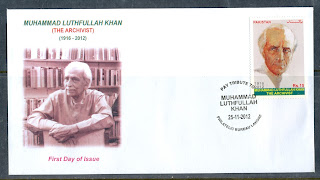
Muhammad Luthfullah Khan 1916-2012 (2012-24)


Muhammad Luthfullah Khan (The Archivist) 1916 – 2012 Commemorative Postage Stamp November 25, 2012:- Muhammad Luthfullah Khan, an Archivist, a Photographer and a Writer, was born at Madras (now called Chennai) on November 25, 1916. His father used to work for the South Indian Railways. He was educated in Madras but moved to Hyderabad later to Mumbai in search of employment. He had extra ordinary fascination for music and singing from his childhood. He participated as amateur singer at the Madras Boys and Girls Exhibition in the year 1931 and received the merit award for Hindustani Music. He signed an agreement  in 1933 for classical singing with the Indian State Broadcasting Service, later re-named as All India Radio. He performed publicly at the age of 19, during a radio concert in 1935. Known as Madras Radio Artist, he sang Ghazals at a function of Muslim Students Association of St. Xavier’s College in January 1939 and rendered classical singing at Bombay in December the same year. After partition he left India and came to Pakistan on October 17. 1947 and settled in Karachi. During quarter century of daily practice (1963 – 1988), he practiced singing with Maulana Abdul Shakoor (newphew of Ustad Abdul Karim Khan) and explored the intricacies of only one raag, the Darbari.
As a young writer his books (Pehloo, Dukhti Ragaeen etc.) were published in early 1936. He performed his first sound recording (voice of his mother) on 29th of July 1951 by using “Sound Mirror” tape recorder, having a single speed of 7.5 inches Per second. Paper tape, coated with magnetic material, was used.
His museum gallery displays rare photographs, photography equipment, international and Pakistani coins, a set of 12 inch 78 rpm discs of Late “Barey Ghulam Ali Khan Sahib”, sound recording equipment and accessories, drawing instrument and stationary items used in documenting the collections and personal items of nostalgic importance as well as a wonderful matchbox collection. (This was his main hobby also). But the pick of this array is an album containing posters of old Hindi and American movies, some of them dating back to twenties. (Late Mr. Theodore Phailbus had the most wonderful collection of Posters in Pakistan). All are arranged in properly illuminated showcases and display boards.
Electronic devices installed include “Revox” tape recorders. Such a broad based collection requires periodic maintenance for which he gas established in a separate room a small workshop with inventory of spares and tools.
His archive contains a large number of rare books on a variety of subjects, including religion. In this personal files, papers are arranged in chronological order in a healthy state. Indexing has been done in simple manner to facilitate easy location of the desired document. His monumental work is un-paralleled in the literary history of the sub-continent.
Different articles were published on his work in the newspapers and magazines. Up to the year 2001, the total number of such essays was 185. Muhammad Luthfullah” Khan penned down eight books pertaining to Urdu literature, Islamic Studies, history and those informing about the lives of great poets and prose writers including:-
1.    Tamashaey – Ahley – Qalam
2.    Sur ki Talaash
3.    Hijratoun key silsiley
4.    Zindagi ka Safar
He has tanscribed all the Urdu Ghazals of Mirza Ghalib into Roman Alphabets. His library comprises the following six categories:
1.    Music of the subcontinent.
2.    Urdu literature – Poetry (Ghazals, Marsia, etc.) and Prose (Novel, Tanqeed etc.)
3.    Religion (Religious books – recitation and narration)
4.    Speeches of public figures including Mr. Mohammad Ali Jinnah, Mr. Liaquat Ali Khan and Mr. Z.A. Bhutto
5.    Education – Mainly Music and Urdu Literature.
6.    Art – Fine Arts, Interviews supported with transparencies, Musical Instruments description with slides.
The music section is further categorized as under:-
1.    Instrumental
2.    Pure Classical
3.    Semi Classical
4.    Ghazal
5.    Geet
6.    Folklore
7.    Qawali
The taped recordings of each category are contained in different colour boxes. Original Gramophone records have been preserved.
Muhammad Luthfullah Khan, till the age of 96 was working to collect cassettes of Urdu verse and prose. He had archived a wide variety of more than 5,000 voices including the speeches of Quaid-e-Azam Muhammad Ali Jinnah, Mahatma Gandhi, Maulana Abdul Kalam Azad and poetry of great poets like Faiz Ahmed Faiz, Friaq Gorakhpuri, Josh Maleeh Abadi, Noon Meem Rashid, Hafeez Jalandhri, Akhtar-ul-Iman and many other eminent poets. Faiz Ahmed Faiz has gifted recording of his poetry in his voice.
Muhammad Luthfullah Khan has computerized his directory of musical collection. The same Raag is indexed for different instruments and vocalists. Among the vocalists he often listens to, with devotion, are Salamat Ali Khan, Amanat Ali Khan, and Roshan Ara Begum. His most liked Vichtarveena player in Pakistan is Habib Khan. Other outstanding instrumentalists include Ustad Bundoo Khan for “Sarangi” and Sharif Khan Ponchwala for Sitar. He considers Villayat Khan as unique in playing of Sitar.
Most of the catalogues have been prepared through computer in the shape of properly bound hard copies. It was too much of a work to be done by a single person.
This is the lifetime achievement of a dedicated hobbyist – indeed a wonderful work, which may not have a match in the Subcontinent.
His birth place in India (Madras / Channai), is said to have another collector of old records namely Mr. V.A.K. Ranga Rao.
In recognition of his splendid contributions to the field of Art, Literature and Culture, which was span on more than 70 years, especially pres4erving national and international Heritage in shape of cassettes, CDs and books, he was conferred upon a large number of awards from different organizations and circles indlucing Presidential Award for Pride of Performance by the President Islamic Republic of Pakistan in 2012, National Literary Award for the year 1998 on his book “Hijratoon Ke Silsle” and Kamal-e-Fun Award (Life time achievements) awards by the Pakistan Academy of Letters, Islamabad.
Muhammad Luthfullah Khan, passed away on Saturday, March 3, 2012 at the age of 96. He was committed and devoted person who spent most of his life collecting voices from different walks of life.
To pay tribute Muhammad Luthfullah Khan (The Archivist), Pakistan Post is issuing a commemorative postage stamp denomination of Rs. 15/- on November 25, 2012.

Diamond Jubilee of Department of Geography University of Karachi Pakistan. (2012-22)


Commemorative Postage Stamp on Celebration of Diamond Jubilee of Department of Geography University of Karachi November 19, 2012:- One of the primate departments of the university, Department of Geography was established in November 1952. Its first Chairman, Dr. M.B. Pithawala was followed by Dr. Oskar Schmeider, Dr. Ibadur-Rehman, Dr. Shamsul Islam Siddiqui, Dr. Muhammad Ismail Siddiqui, Prof. Abdur Rauf Khan, Mrs. jamilaSarwar, Dr. Fazla Karim Khan, Dr. Iqtiday Husain Zaidi, Dr. Qazi Shakil Ahmed, Mr. Syed Asif Ali, Dr. (Mrs.) RAzia Afzal Niazi, Prof. Dr. Birjies Talat, Prof. Dr. FArkhunda Burke, Prof. Dr. Syed Jamil Hasan Kazmi, Prof. Dr. Khalida Mahmood and the current Chairperson Prof. Dr. FArkhunda Burke who have earnestly and painstakingly taken the department from its inception to the status of a glittering diamond. The department has been fortunate to be served by eminent, internationally reputed geographers and faculty including the uncoming, enthusiastic faculty members.
The department is housed in a two-storeyed building with lecture rooms, research laboratory, a well catalogued seminar liberary, staff rooms, girls’ common room etc. The Seminar Library containing more than 2000 books acquired by the department, through donations by retired teachers and ex-students, caters to the needs of more than 450 students. The Map Library containing about 3000 maps, ranging from topographical maps of various areas, maps of various cities and administrative maps of different scales; some aerial photographs and satellite imageries are available in the Department. The wall maps along the corridors pertaining to various regions of the world, and varying fields of geographic specialization give the department a geographic air. Satellite imageries of Pakistan and Karachi mounted on the elevations, express that maps are an essential tool of geography.
New perspectives in geography have evolved with the advent of Geographical Information System (GIS), Remote Sensing (RS) and Computer Aided Design (CAD). The department boasts of a computer laboratory for hands on working of students. A fully computerized research laboratory has been inaugurated by the Dean Faculty of Science, Prof. Dr. Nusrat Jamil, to cater to the thirty two registered research scholars.
An ‘A’ class Meteorological Laboratory established in 2003, in the foreground of the department is located on the WMO map. Regular reading are regularly dispatched by Supporting Staff trained for this purpose. The Abdur Rauf Khan Museum of Pre-History, contains relics of pre-historic cultures of Pakistan, collected from an area extending to about 120 miles around Karachi. The material ranges from early Paleolithic age through Middle and upper Paleolithic, Mesolithic and Neolithic to Harappan Age. Vertebrate fossils of Miocene Age derived from Sindh Kohistan and coastal areas of Sindh and Balochistan are on display in the museum.
To commemorate Celebration of Diamond Jubilee of Department of Geography University of Karachi, Pakistan Post is issuing a commemorative postage stamp of Rs.15/- denomination on November 19, 2012.

92nd Birth Anniversary of Hameed Naseem. Men of Letters. Pakistan (2012-21)


92Nd Birth Anniversary Of Hameed Naseem Commemorative Postage Stamp October 19, 2012:- Hameed Naseem was Mufasser-e-Quran, Poet, Writer, Critic, former Deputy DG Radio Pakistan, former Director of the PIA Arts Academy, an acclaimed broadcaster and was called “broadcaster” by critics and his contemporaries. He was born on 6th October, 1920 at Shah Pur Kundi, District Gurdaspur. He was a prodigious learner and poet and started writing poetry at an early age in School days. He got opportunities to intermingle with poets and intellectuals like Faiz Ahmed Faiz and Dr. M.D. Taseer who were close friends of his father Abdul Aziz, known as Aziz Bitalvi, who had profound interest in poetry. He matriculated from M.B. High School Lahore and graduated from MAO College Amritsar. Later he moved to Lahore and did his M.A. Engilish from Islamia College Lahore where he was the leading poet, orator, and prose writer of the College and was especially known for his melodious voice (taranum) which always swayed the mushairas by its profound effect. During these days, he was a regular visitor of the famous Arab Hotel, which lay across the Islamia College Lahore and Nageena Bakery near Anarkali; both places were established rendezvous for the literati, poets, and scholars of the thirties and early forties and other intellectual community of Lahore. It was during this time that he received poetic inspiration and guidance from Sufi Tabassum and developed lifelong friendship with him as well Zia Jallandari, a leading poet and who regularly prodded poet inside him and motivated him for other research and literary endeavors.
His Tafseer-e-Quran, named, Ta’aruf Al Furqan, is composed of 5 volumes and provides in-depth and detailed commentary on Quran, with references to comparative religions. He wrote booklets, Aurat Islam Ki Nazar Main, for general readers to remove their some misconceptions about the role of woman in Islam and The Message of Islam, for the English speaking communities for better understanding of the basic Islamic concepts.
He was a promising poet of his times and his collection of poetry, Dood-e-Tahayar (The Smoke of Wonderment), is an important work of classical ghazal structures, and shows his confident grasp of the art of poetry writing which is guided by the rules of poetry and its rhetoric. His collections of poetry, Jast-e-Janoon, Gard-e-Malal, are also rated as valuable to Urdu literature. He was also a known critic who wrote critique on many poets and his book, Allama Iqbal Hemaray Azeem Shaaer, Panch Jadeed Shair, Kuch Aur Ahim Shair, introduction to Kuleeyat Shafeeq Fatima, are widely acclaimed among the literati circles. His book, “Allama Iqbal Hemaray Azeem Shaaer” was awarded Presidential Award posthumously on Iqbal Day in 2003 which was received by his widow, Nafisa Begum, and daughter, Seemin, from the President of Pakistan at the occasion of Iqbal Day in Lahore.
Notwithstanding his great contribution of producing 5-volumes’ of comparative religion commentary on Quran Hakeem, his autobiography Namumkin Ki Justajo, published in 1990, will remain his most memorable work and is still rated one of the best autobiographies in Urdu literature. This autobiography is unique in two ways – firstly, it is written in third person and secondly, it shows a picturesque kaleidoscope of cultural and literary life in Lahore and Amristar and in many parts of the world in those times, wherever he lives or visited, which have now vanished, and his contemporary personalities and events. It vividly portraits the days at MAO College Amristar, Islamia College Lahore, early days of Radio, and events of his colleagues like Meeraji, Noon Meem Rashid, Krishan Chander, greatest of them all, Prof. A.S. Bukhari, the first Indian to become Director of All-India Radio. Due to these peculiar characteristics of this autobiography, it has been called Ahad Nama by the critics.
Mr. Hameed Naseem also served as Director of the PIA Arts Academy in 1967 for few years and used his talents as a programme person in the promotion of Pakistan art and culture at international levels, mostly the destinations of the PIA at those times. At the twilight of his life and career, Mr. Hameed Naseem was researching and writing, Adbi Urdu Nasar, which could not be published due to his sudden death in 1998 and is still available with his heirs as a manuscript.
He was one of the pioneers and founders of Radio Pakistan after the creation of Pakistan. He started daily programme, Pakistan Hamara hay, from Radio Station Lahore which tried to inculcate national integration among the newly founded nation. He wrote many national songs (Qaumi Taranay) during the wars of 1965 and 1971 which were sung be eminent singers like Ustad Amanat Ali, Farida Khanum, Noor Jeha,. He had a long career in Radio Pakistan and was widely respected as a famous broadcaster and many posthumously remember his reputation as broadcasters’ broadcaster. He also served at BBC in London for few years on deputation but returned to Pakistan for love of the people and the country and declined all lucrative offers of staying at the BBC. The BBC remembered his contributions by placing a floral commemorative wreath on his grave after his death. He strated the programme, Roshni, and Quran-i-Hakeem aur Hamari Zindigi and conducted the programme himself for years in his typical broadcaster’s voice. This religious programme was so much popular among the listeners that it was broadcasted for decades till recent years. He was also founder of the Radio Station Hyderabad and appointed its first Station Director. Hameed Naseem retired as Deputy Director General but kept serving the Radio Pakistan as Advisor on Religious Affairs till the time of his death, and even performed his duties on the last day of his life, 28th September 1998.
His death was widely mourned in the literary circles, Radio Pakistan, PTV, and the electronic media relayed news and the print media published news reports as well as special features. Many famous poets and writers wrote obituaries in the national dailies and Literary Magazines, acknowledging his contributions for the Urdu literature, religion and Radio Pakistan. Hameed Naseem will always be remembered for his valuable contributions to Urdu literature, Poetry, history of Pakistan, and most importantly expounding our great religion.
On 92nd Birth Anniversary of Hameed Naseem, Pakistan Post is issuing a commemorative postage stamp of Rs.8/- denomination on October 19, 2012.

Saturday, November 13, 2010

2nd Allama Iqbal Stamp Show - 2010

Wahid Zia Owner of paknetmag Blog
Group Photo of Stamp Collectors

2nd Allama Iqbal Stamp Show - 2010
Allama Iqbal's Tomb, Lahore November 09, 2010
The 2nd Allama Iqbal Stamp Show - 2010 held on Iqbal Day, November 09, 2010 at Allama Iqbal's Tomb, near historical Badshahi Mosque, Lahore organized by Mian Sajid Ali of Allama Iqbal Stamps Society. 6 frames (96 pages) displayed here which attracted the people. Pakistan Post also arranged its stall here which was the first time in the history of Lahore on any solo exhibit. Some famous personalities visited here including Mr. Shahzad Qaiser (Vice President - Iqbal Academy Pakistan), Muhammad Suheyl Umar (Director - Iqbal Academy Pakistan), Mr. Munib Iqbal & Mr. Waleed Iqbal (Grandsons of Allama Iqbal), Mr. Majeed Nizami (Chairman - Nawa-i-Waqt Group), Professor Rafiq Ahmed (Deputy Chairman - Nazaria Pakistan Trust), Mr. Mujeeb-ur-Rehman Shami (Chief Editor - Daily Pakistan), Dr. Abdaal Bela (Deputy Chairman - Pakistan Academy of Letters), Miss Faiza Ahmed Malik (Parliamentary Secretary & President Women Wing, Pakistan People's Party), Mr. Mansoor Ahmed (Senior Manager Purchase - Berger Paints Pakistan Limited) etc. Some philatelists also came for 2nd Allama Iqbal Stamp Show - 2010 including Mr. Wahid Zia (Pak Net Mag), Major (R) Dr.Saif-ul-Hassan Rizvi, Mr. Azhar Iqbal, Mr. Muhammad Tahir, Mr. Syed Saeed Hassan Zaidi. Crowd of all ages came to see the exhibit including politicians, students, philatelists, writers and foreigners. Mian Sajid Ali (Owner of Allama Iqbal Stamps Society) awarded a medal by Mr.Wahid Zia of Pak Net Mag for his successful second consecutive stamp show on Allama Iqbal's 133rd birth anniversary. Allama Iqbal Stamps Society issued a Souvenir Cover and Commemorative Post Mark on this occasion which was available from the stall of Pakistan Post at the event. Samaa TV recorded a documentary on Allama Iqbal Stamps and postal stationary which was telecast on Iqbal Day, November 09, 2010, in her detail news. Some other media channels covered the stamp show including ARY Digital, Waqt News, Rohi and CNBC Pakistan. A short but brief program recorded by Mr.Mujahid Abro for his program Dosra Pehlu about 2nd Allama Iqbal Stamp Show - 2010 which was telecast on the same day in night on CNBC Pakistan. A lady reporter, Miss Sadaf Kashif, of Daily Ashsharq also covered it for press media. A short report of stamp show published on November 10, 2010.

Friday, August 21, 2009

Independence Day. (2009-9)

Independence Day:- The first brick in the foundation of Pakistan was laid in 712 A.D. when Mohammad Bin Qasim anchored at Debal Port (now know as Karaqchi), freed the Muslim women and children from the prisons of Raja Dahir and constructed the first mosque in the town. Quaid-e-Azam Mohammad Ali Jinnah, the Founder of Pakistan, acclaimed the event by stating “the Pakistan Movement started when the first Muslim put his foot on the soil of Sindh – the Gateway of Islam in India”
The Pakistan Movement was synonymous with the very spirit of Islam. The War of Independence in 1857 was an open manifestation of the Muslim Spirit of revolt against the domination of British Government and its stooges in India. Frustration and lack of direction, however, pervaded the rank of Muslims after the unfortunate failure in the War. At this critical juncture emerged Sir Syed Ahmed Khan who served as a beacon of light for the Muslim Nation in distress and disarray. He equated education with power and declared that Muslims could improve their political, social and economic condition only through the medium of modern and scientific education. He cultivated the concept of a separate Muslim Nation on the basis of religion, culture and history. “He inspired the Muslims of the Sub-Continent to demand a separate homeland” where they could arrange their lives and affairs of the state according to the dictates of the Holy Quran and Sunnah.
After the partition of Bengal in 1905, the opposition of the Indian National Congress and its leadership compelled the Muslims to establish a political party to protest their rights. Thus in 1906, the Muslim league was founded as a challenge to the Indian National Congress. Maulana Hasrat Mohani presented a plan to the Government for the country envisaging two separate states for the Hindus and Muslims.
Chaudhary Rehmat Ali further developed this concept and coined the word “Pakistan”. He displayed great wisdom and foresight by putting forth not only a name but in large measure the scheme that culminated in the creation of Pakistan. Maulana Muhammad Ali, Maulana Shakat Ali and Maulana Zafar Ali Khan spread the message of Movement through their lucid lectures and articles in newspapers.
Allam Iqbal iniated his efforts in the second decade of twentieth century to awaken the Muslims of India from the state of slumber which had dangerously retarded their moral and material progress leaving them far behind in the race of opportunities. He determined to extract the Muslim community from the backwardness by infusing a burning zeal among the depressed and dejected Muslims, lost in the wilderness.
Allam Iqbal, being conscious of the implications of the political development, propagated his ideas about a separate state for the Muslims in his Presidential Address delivered on 29th of December 1930 at Allahabad. Presiding over the 31st session of the All India Muslim League he said:”The principle of European democracy cannot be applied to India without recognizing the fact of communal groups. The Muslim demand for the creation of Muslim India within India is, therefore, perfectly justified.
After a great and heroic struggle by Muslims of the sub-continent, under the dynamic leadership of Quaid-e-Azam Muhammad Ali Jinnah the British Parliament was forced to approve the Indian Independence Act, 1947 leading to the birth of Pakistan on 14th August, 1947. On this historic day, the Quaid-e-Azam while addressing the first session of Constituent Assembly of Pakistan in Karachi eulogized the services and sacrifices of the Muslims of the sub-continent to achieve Pakistan in the following words:-
“My thoughts are with the valiant fighters n our cause who readily sacrificed all they had, including their lives, to make Pakistan possible”.
Thus the response of the millions, sacrificing their lives and homes, to the call of “Unity, Faith and Discipline” from their Quaid-e-Azam firmly placed Pakistan on the world map.
The Governor General of Pakistan, Quaid-e-Azam Muhammad Ali Jinnah, in his address at the University grounds on Thursday 30th October, 1947, the biggest public meeting in the political history of Lahore said,
“We have achieved our cherished goal of freedom and have established Pakistan as an independent sovereign state, fifth largest in the world. The freedom can never be attained by nation with out suffering and sacrifice, has been amply borne out by the recent tragic happenings in unparalleled difficulties and untold sufferings, we have been through dark days of apprehension and anguish: but I can say with confidence that with courage and self-reliance and by the grace of God we shall emerge triumphant”.To commemorate the Independence day. Pakistan Post is issuing a Commemorative Postage Stamp Rs.5/- denomination on August 14, 2009.

Thursday, August 20, 2009

Pioneers Of Freedom (Series) August 14, 1990


  • Allama Muhammad lqbal
  • Quaid-e-Azam
  • Sir Syed Ahmed Khan
  • Sir Khan Salimullah
  • Mohtarma Fatima Jinnah
  • Sir Sultan Mohammad Shah Agha Khan III
  • Nawab M. Ismail Khan
  • Hussain Shaheed Suharwardi
  • Syed Amir Ali
  • Liaquat Ali Khan
  • Fazlul Haq
  • Shabbir Ahmad Usmani
  • Sardar Abdul Rab Nishtar
  • Bi-amma
  • Abdullah Haroon
  • Ch. Rehmat Ali
  • Raja Sahib Mahmudabad
  • Hassan Ali Effendi
  • Bahadur Yar Jung
  • Khawaja Nazimuddin
  • Obaidullah Sindhi
  • Khan Abdul Qaiyum Khan
  • Begum Shah Nawaz
  • G. H. Hidayat Allah
  • Qazi Isa
  • Shahnawaz Khan Mamdot
  • Pir Mandki Sharif

Pioneers of Freedom (Series) August 14,1992

SYED SULEMAN NADVI
Syed Suleman Nadvi was born in 1884 in village Deesna of District Patna. His father, Hakeem Syed Abul Hassan had a great respect amongst the masses because of his piety, politeness and nobility. Syed Suleman Nadvi acquired his primary education at his home and attained Arabic education at Phalwari Shareef and Madras-e-lmdadia Darbhanga for some time. In 1901, he attached himself with Darul-Aloom Nadva for higher religious and Arabic education. The academic atmosphere at Nadva was quite exemplary, which polished Syed\'s literary taste. At Nadva, Syed got opportunities of acquiring bounty from great scholars like Maulana Farooq Charyakoti, Syed Muhammad Ali, Maulana Hafeezullah and Maulana Shibli Naumani. At Nadva, Syed acquired skill in writing laudatory poems in Arabic and Persian.
Syed was the most dignified student of Maulana Shibli Naumani and was greatly influenced by him. He got a special skill in writing and oratory under the able supervision of Maulana Shibli Naumani. He also acquired training in philosophy, literature and history from Nadva. He was very keen in research methods and possessed great mastery in criticism. He had a great trend towards mysticism and simplicity.
Syed attached himself with a paper titled \"AI-Nadva\" of Maulana Shibli Naumani in 1904 and became its editor in 1906. He acquired a great command in Arabic language and literature at Darul-Aloom Nadva. He was a prompt and an eloquent orator of Arabic. In 1908, he was appointed teacher of Modern Arabic Literature, Science and Religion at Darul-Aloom Nadva. During this time, he wrote two books under the title of \"Daroos-ul-Adab\" which have still great importance in Arabic literature. He was appointed as Secretary Education of Darul-Aloom Nadva in 1915.
NATIONAL SERVICES
Darul Aloom Nadva, although a religious institution, was also making efforts in creating political consciousness amongst the Muslims of India. Many religious scholars attached with this great institution were staunch supporters of the movement launched by Sir Syed Ahmad Khan. Syed Suleman Nadvi, like his teacher Shibli, did not wish that the Muslims should join the Congress. He advised the Muslims to keep themselves aloof from the Congress. He believed that if India succeeded in attaining freedom at any time, the Congress will play the role of a lion and the ~ Muslim League would become its victim like a fox.
His attachment with Al-Nadva and AI-Hilal, made him fully aware of the political conditions of the Muslims of the world in general and of India in particular. Syed was also conscious of the changes which were taking place in the beginning of the 20th century. Through the above mentioned circumstances it appears that Syed kept informed the Muslims of India about the alarming situation and designs of their foes. During the Khilafat Movement, Syed also used his pen forcefully to give momentum to the movement. He also accompanied the delegations of the Khilafat Committee to Europe, where he projected the rights and demands of the Turkish as well as the Muslims of India. Syed had declared India as \"Darul Harrab\" because of her peculiar conditions.
During a conflict between Sheriff of Mecca and Shah lbn-e-Saood, Syed led the delegation of Khilafat Committee to Hejaz in 1926. Syed, while representing the sentiments of the Muslims declared without hesitation that a democratic system should be introduced in Arabia. He also participated in the Conference of Motamar-e-Alam-e-Islami at Mecca in the capacity of its Vice President.
Syed with his untiring efforts eliminated the effects of Shuddhi and Sanghtan Movements launched by Swami Shirdhanand. By this way, he not only protected the Muslims but also guarded their Islamic entity and religious beliefs. Syed not only worked at educational front for the well being of the Muslims but also participated in every movement which was meant for the liberation of the Muslims of India.
Syed attached himself with Shibli Academy in 1916 from where he published some important books which later played a prominent role in the training of new generations. He was a great scholar and a historian of repute. He possessed great skill as a critic of poetry. He was a great admirer of \"Seerat-un-Nabi\" written by Maulana Shibli Naumani and credit of its completion also goes to him. He wrote \"Seerat-e-Aysha\" in 1910 and Arz-ul-Quran\" in 1918. He also wrote a book on Umar Khayyam, in which he has discussed his services in detail. He published collection of his essays \"Naqoosh-i-Sulemani\" in 1939. He also wrote a detailed history of Maulana Shibli Naumani. He delivered sermons on the life of the Holy Prophet (peace be upon him), which have also been translated into English. He produced \"Daroos-ul-Adab\" and also prepared a dictionary of new Arabic words.
He was awarded the degree of D.Litt. by the Muslim Aligarh University in 1941 on account of his services rendered by him in education, literature and religion.
Syed was very much disappointed on account of atrocities inflicted upon the Muslims at the time of partition. He decided to come to Pakistan although he was requested by the Prime Minister of India to stay. He came to Pakistan in 1950 and was appointed President, Board of Taleemat-e-Islamia in 1950. This Board was a part of the Constituent Assembly of Pakistan. He died in 1953.
MAULANA MUHAMMAD SHIBLI NAUMANI
Maulana Mohammad Shibli Naumani was born in May 1857 at village Bandol of Azamgarh. His father, Sheikh Habibullah was a Raees-e-Azam of the city, a successful industrialist and a lawyer of great repute. Shibli was the eldest son of his father, whose birth was celebrated with great pomp and show.
Shibli completed his education in 1876 and had acquired sufficient command over Arabic, Persian and the understanding of the Holy Quran. He was fortunate to learn from great scholars of the time like Maulana Muhammad Farooq, Maulana Abdul Hayee Farangi Mohalli, Maulana Irshad Hussain Mujaddadi, Maulana Faizul Hassan Saharanpuri and Maulana Ashraf Ali Thanvi. But Maulana Muhammad Farooq left a lasting impression on his personality. These religious scholars equipped Shibli with real knowledge in various fields. His literary taste was polished and trimmed by Maulana Muhammad Farooq to a large extent and he was very much impressed with the capabilities that Shibli possessed. Shibli was quite satisfied with the education he had attained from various sources. But two things disappointed him very much. Firstly, he was unable to get an employment of his own choice for a period of seven years (1876-83). Secondly, the movement of Sir Syed Ahmed Khan for spreading Western Education was a point of worry for him because he was trained in traditional/oriental studies. This, how-ever, did not allow Shibli to give up or surrender. Instead he faced the circumstances very boldly and courageously. He practiced as a lawyer at Azamgarh for sometime, but soon left this profession. Then he began to assist his father in his business, but this too did not suit his temperament. In fact, Shibli\'s destination was somewhat different.
In the beginning, he was against the educational scheme of Sir Syed Ahmed Khan, but later he had to compromise with the thoughts of this great reformer. This change came in Shibli\'s personality, when he had the occasion of working with Sir Syed Ahmed Khan at MAO College, Aligarh. Some times, affinity with great personalities and the impact of their thoughts is so influential that it creates a great revolution in the beliefs, imaginations and lives of their associates. The same happened with Shibli and he benefited a lot from Sir Syed Ahmed Khan\'s association. In 1883, Shibli was fortunate to get an appointment at MAO College as a teacher of Oriental Sciences. This was the time when Shibli acquired skill in the art of poetry and composed many poems and odes. His poetry was a reflection of national thoughts which was because of academic environment of MAO College. Shibli successfully roused the feelings of the Muslims of India by writing/composing a Masnavi titled \"Subah-e-Umeed\", which became very popular.
At Aligarh, Shibli did not waste his time but concentrated all his energies in learning. This was because of the reasons that MAO College\'s library had plenty of rare books on various subjects. This made Shibli a good historian and writer. At Aligarh, he learnt French from Professor Arnold and taught him Arabic. His literary efforts and discourses added to the popularity of Aligarh College. An essay under the title of \"Musalmanoon ki Guzashta Taleem\" read by him in Muslim Educational Conference earned him great respect and repute. Shibli continued teaching as well as writing and published his popular book \"Al-Mamoon\", which negated all the charges leveled against Haroon-ul-Rashid by Palmer. He was able to write \"Seerat-un-Nauman\" in 1890 which indicates his attachment with lmam Abu Haneefa.
Besides, he wrote many historical literary and research articles from 1892 to 1898. The publication of these works made Shibli not only a great writer but also brought fame, respect and repute for him. The British Government awarded him with the title of \"Shamsul Ulama\" on account of his academic performance.
Because of Sir Syed Ahmed Khan, Shibli was able to establish connections with Nawab Umadul Mulk, Syed Hussain Bilgrami and his brother Syed Ali Bilgrami. He was awarded a Scholarship of Rs. 100/- per month by the Nawab. After he left Aligarh, he got an employment as Director of an institution \"Sarishta-e-Aloom-u-Fanoon\" established on the advice of Syed Ali Bilgrami. During his stay at Hyderabad, he was able to complete \"Al-Ghazali\" in which he has very skillfully analyzed the concepts and philosophy of lmam Ghazali. He also wrote books like \"llm-ul-Kalam\" and \"Al-Kalam\".
RELIGIOUS SERVICES
Although Shibli was too much busy in his job and writing books on various topics, yet he did not ignore the religious aspect and did participate in every such activity as and when he got time. He actively participated in \"Vakf-ul-Aulad\" Bill of 1 908, Friday Holiday in Government Offices during 1912, \"Vakf-e-lslami\" and \"Fitna-lrtidad\" etc. He had a great love for Turkey and very courageously wrote an essay in \"Azad Akhbar\" in favour of Turkey. He started a paper under the name of \"Muslim Gazette\" from Lucknow in 1912. In this paper Shibli used to write essays on political issues and successfully diverted the attention of the Muslims of India towards their actual objectives. Shibli separated himself from \"Darul-Aloom-Al-Nadva\" in 1913 and came back to Azamgarh. Here he started \"Madrassa-tul-lslah\". He also founded an institution \"Darul-Musanifeen\", which he could not complete during this life time. It was later completed by his pupil Syed Suleman Nadvi.
Maulana Shibli was a great lover of the Holy prophet (peace be upon him). During his stay at Aligarh, he had produced a Journal \"Badr-ul-Islam, which was included in the syllabus of Aligarh College. On account of his respect and emotional love for the Holy Prophet (peace be upon him), he started writing \"Seerat-un-Nabi\", but was unable to complete on account of severe illness. Before his death, he advised his pupil, Syed Suleman Nadvi that \"Seerat is the earning of my life, do complete this work ignoring everything.\" This indicates how much importance did he attach to this work.
Shibli was a great scholar and he did contribute a lot through his pen for the Muslims of India and later generations benefited to a great extent from his writing. He was awarded Tamgha-e-Majeedi by the Sultan of Turkey. He became Fellow of Allahabad University and a member of Royal Asiatic Society.
Shibli was the founder of the following institutions:
1. Shibli National School, Azamgarh
2. Darul-Aloom Nadva, Lucknow
3. Darul-Musanifeen, Azamgarh
He died on November 18, 1914.
NAWAB IFTIKHAR HUSSAIN KHAN MAMDOT
Nawab Iftikhar Hussain Mamdot was born at Lahore in 1906. His father, Sir Shah Nawaz Khan Mamdot was a great political and social figure of the Punjab. The Mamdot family enjoyed great respect amongst the masses because of its popularity, prosperity and national services. After completing his education from Government College, Lahore, Mamdot joined police service at Hyderabad Deccan. But the police services did not suit his temperament and soon he left the job.
At that time, the Unionist Party of Sir Fazal Hussain had the support of all the big landlords of the Punjab and it had also considerable influence in the Council. The Muslim League was not so popular in the province at that time. Nawab lftikhar Hussain Khan Mamdot had a great political foresight and preferred to join the Muslim League. He was of the opinion that it was the Muslim League only which really represented the aspirations of the Muslims of India. His father, Sir Shah Nawaz Khan was a prominent figure of the Punjab and was loyal to the Muslim League from the core of his heart.
In 1937, when Quaid-i-Azam Muhammad Au Jinnah and Sir Sikandar Hayat Khan agreed through a pact to include the Muslim Leaguers in the Assembly, the leadership of the Punjab Muslim League was assigned to Iftikhar Hussain\'s father. Iftikhar Hussain Khan supported the cause of the Muslim League and actively participated in its affairs. He became the President of the Punjab Provincial Muslim League in 1942 after the * death of his father. He wished that the Muslim League should be strengthened so that it could compete with the Unionist Party. For this purpose, he worked day and night and organized the Muslim League on sound footings in accordance with the wishes of his leader Quaid-i-Azam. He was a firm believer of party discipline and never took any decision before taking into confidence the members of the party.
Quaid-i-Azam Muhammad AU Jinnah had a great confidence upon Mamdot and believed that he was very sincere and dedicated to the Muslim League. During a fund collection campaign for the Punjab Provincial Muslim League, Nawab Mamdot donated Rs. 5000/- for the purpose.
Nawab Mamdot, while presiding over a conference of the Muslim League ( at Karnal in May 1942, demanded that the Muslims of India should be given their legitimate rights and India be partitioned. He stressed upon ~ the Muslims for unity and demanded loyalty from them for the Muslim League. Quaid-i-Azam Muhammad Ali Jinnah was so pleased from his Karnal\'s address that he wrote a congratulatory letter to him in which he hoped that \"you will definitely follow your father\'s footprints\". Despite the fact that Malik Khizar Hayat Khan, Chief Minister of the Punjab was not sincere to the Muslim League, Nawab Iftikhar through his dynamic leadership succeeded in strengthening and expanding the Muslim League in the entire province.
Because of the flexibility in the constitution of the Muslim League, most of the prominent Muslims of the Punjab had also acquired the membership of the Unionist Party. Sir Chootoo Ram through his speeches and statements, was trying to attract the workers of the Muslim League towards the Unionist Party. Nawab Iftikhar Hussain Khan was fully aware of the Intrigues and conspiracies of the Unionist Party. He also knew that if a lenient attitude was adopted at this stage, the Unionist Party will succeed in weakening the Muslim League. He informed the Muslims about the pro-British activities of the Unionist Party and in this way did not allow Unionists to succeed in their vicious aims. It was his devotion and loyalty, which strengthened the Muslim League to such an extent that none had the courage to speak against this party in the province.
Nawab Sahib was a straightforward person and opposed those who followed dual policy. Because of the dual policy of some of the Muslim members of the Unionist Party, the image of the Muslim League was being shattered. Nawab Sahib firmly believed that Malik Khizar Hayat Khan was a British\'s stooge and he did not wish to see the Muslim League flourish in the Province.
This was because of his efforts that Malik Khizar Hayat Khan was ousted from the Muslim League in the beginning of 1944. Mamdot was the man who made the Unionist Party totally ineffective in the Punjab. He bitterly cirticised the policies of the Unionist Party and actively participated in the civil disobedience movement for the elimination of the Unionists from the Punjab.
During the provincial elections of February 1946, the hard work and efforts of Nawab Iftikhar Hussain Khan Mamdot brought fruit and the Muslim League was able to capture 79 seats in the province. It was a great victory fo the Muslim League and was a clear proof to the fact that the Muslims of the Punjab had all their sympathies and support for the Muslim League and idea of Pakistan. Quaid-i-Azam Muhammad Ali Jinnah congratulated Nawab Iftikhar Hussain Khan Mamdot through a telegram at this victorious occasion.
After independence, Nawab Iftikhar Hussain Khan Mamdot remained the Chief Minister of the Punjab upto 1948. He was also a member of the Constituent Assembly of Pakistan till 1 955. He also worked as Governor of Sindh during 1954-55. He died on October 16, 1969.
(Contributed by: Quaid-i-Azam University, Islamabad.)
To commemorate the Pioneers of Freedom (Series) Pakistan Post Office is issuing a set of three postage stamps of Re. 1/-denomination on August 14, 1992.